Showing posts with label Weather. Show all posts

Friday, 16 January 2015

18th January: White horses on the shore

High winds and gales have continued to batter the Northeast coast this week, with Lindisfarne being no exception.

In addition to our blog post about the Lough hide roof damage and Brent geese hunkered down on Holy Island, we bring you views of 'white horses' rolling in to the shores of the Island during the strong winds last week.


The high winds seem to have abated this week but have been replaced by snow and ice! This is still balmy however when compared to the Arctic breeding grounds of many of our wintering bird species.


15th January: Brent geese on farmland, Holy Island

Around 300 Dark-bellied and 50 Light-bellied Brent geese have been spotted sheltering on farmland during the recent high winds. Reserve staff spotted the birds whilst out replacing signs so took these photos, not bad for a small digital camera!


These charismatic small geese can often be spotted feeding on the mudflats from the Causeway and from the hide at Fenham-Le-Moor.

Wednesday, 14 January 2015

14th January: Lough hide roof damage

Unfortunately the recent strong winds and gales have caused damage to the Lough hide roof, blowing off a large section of the corner.

The hide was due for replacement this year anyway, but unfortunately we have had to close it unexpectedly early because of the damage to the roof.

The hole in the hide roof
 
Unsafe for visitors


Monday, 10 February 2014

4th February: January peak bird counts

Some selected peak bird counts from January's co-ordinated Wetland Bird Survey. The weather for this day was poor with a rough sea but still some great numbers of birds were seen:

Pink-footed goose: 2000
Barnacle goose: 250
Light-bellied Brent goose: 1100
Greylag goose: 128
Whooper swan: 15
Wigeon: 900
Shelduck: 1318
Pintail: 230
Long-tailed duck: 20
Bar-tailed godwit: 1053
Oystercatcher: 974

Thanks to all our volunteers who give their time every month to carry out this survey across the NNR.

31st January: Two days in the life of the Window on Wild Lindisfarne

We invite volunteers and others who work with the Reserve team to write pieces for this blog. Today we have a special blog post from one of our volunteer guides, David, giving an insight into what it is like to be a guide on Lindisfarne NNR. David explains how the Reserve, normally busy with visitors, can have quiet days too!

David tells us:

“The afternoon of Tuesday 21st January was sunny and almost still but cold. The Window on Wild Lindisfarne building was very busy both inside and out. Visitors arrived at the rate of 45 adults per hour plus children and dogs. Several couples, some with babies were staying on the Island and all the rest bar one couple were from a distance, all from further south than Newcastle. Lots of birds enjoying the flooded scrape. About 100 each of Brent geese, curlew, teal and lapwing. They were mostly on the scrape but commuted to the next door field to the west. Plus lots of gulls and starlings. Having packed up, I walked round the water's edge to the Lookout on Wild Lindisfarne (old Coastguard Tower) to discover that the Brent geese had flown over the building just as far as the shoreline in the harbour near the upturned boats.

Drake teal: Europe's smallest duck, and one of our most beautiful, can be seen from the Window on Wild Lindisfarne throughout the winter

However, on the following Monday afternoon (27th) it was all together different. Cold, wet and very windy. Like a chump I misread the tide tables and arrived early for the safe crossing but it was very interesting to watch both humans and birds during my wait of about 30 minutes! Having stopped close to the water's edge on the causeway there were lots of birds to see. Many small groups of shelduck flew over southwards at about 20 metres height. About 10 each of oystercatchers and curlew paddled about. A huge flock of small waders flew about like a murmuration of starlings but I couldn't identify them. Amazingly, there was a long straight line of Brent geese parallel to the causeway about 500 metres to the north (I set up the telescope) and every so often about 25 would take off and fly south over me, very close, at about 5 metres height. Some of the humans were impatient. By now there were 2 white vans and 4 cars waiting to drive over to the Island. One car driver set off into the water which soon covered the wheels and he very, very quickly reversed out.

Flock of oystercatcher: these striking birds can be seen from the causeway

On reaching the Window building there were only gulls on the scrape and they promptly took off and then no birds (or people) for an hour. I gave up to go home and it was really windy outside, hence the lack of people and indeed, the main car park had only 2 cars in it as I left!”

David, and our other volunteers who act as guides in the Window on Wild Lindisfarne, do a fantastic job of informing visitors about the amazing wildlife of Lindisfarne NNR. David's story shows how dedicated they are, and that even on bad weather days there is still much to see on the Reserve!

Friday, 6 December 2013

6th December: Storm surge aftermath

Today, the Reserve team headed out to assess the damage from the exceptionally high tides caused by the storms that hit the North East on the 5th December. These tides are reported to be the highest seen here for at least 60 years.

Around 3 metres of dunes have been lost from this section - you can see where they used to exist where the marram remnants are on the beach.

Collapsed foredunes near the Beacons at Ross

Between 3 and 5 metres of foredunes from the North shore of Holy Island and from Ross were lost. The huge waves removed the marram grass from the dunes, exposing the sand underneath which was undercut by the waves.

Thankfully, the very important little tern breeding areas are still intact. The storm may even have created new habitat for little terns which they could use next year.

Our flooded hide!

The high tide breached the bank and flooded the hide at Fenham-Le-Moor, you can see how far the water came up the wall on the above picture. The water was swept out and the doors have been left open, so hopefully it won't be long until it is dry again.

Thankfully, there have been no casualties that we are aware of and no really dangerous damage to parts of the Reserve.


Tuesday, 19 November 2013

19th November: Winter Is Here

Winter has arrived on Lindisfarne! The Reserve had its first snowfall this morning.

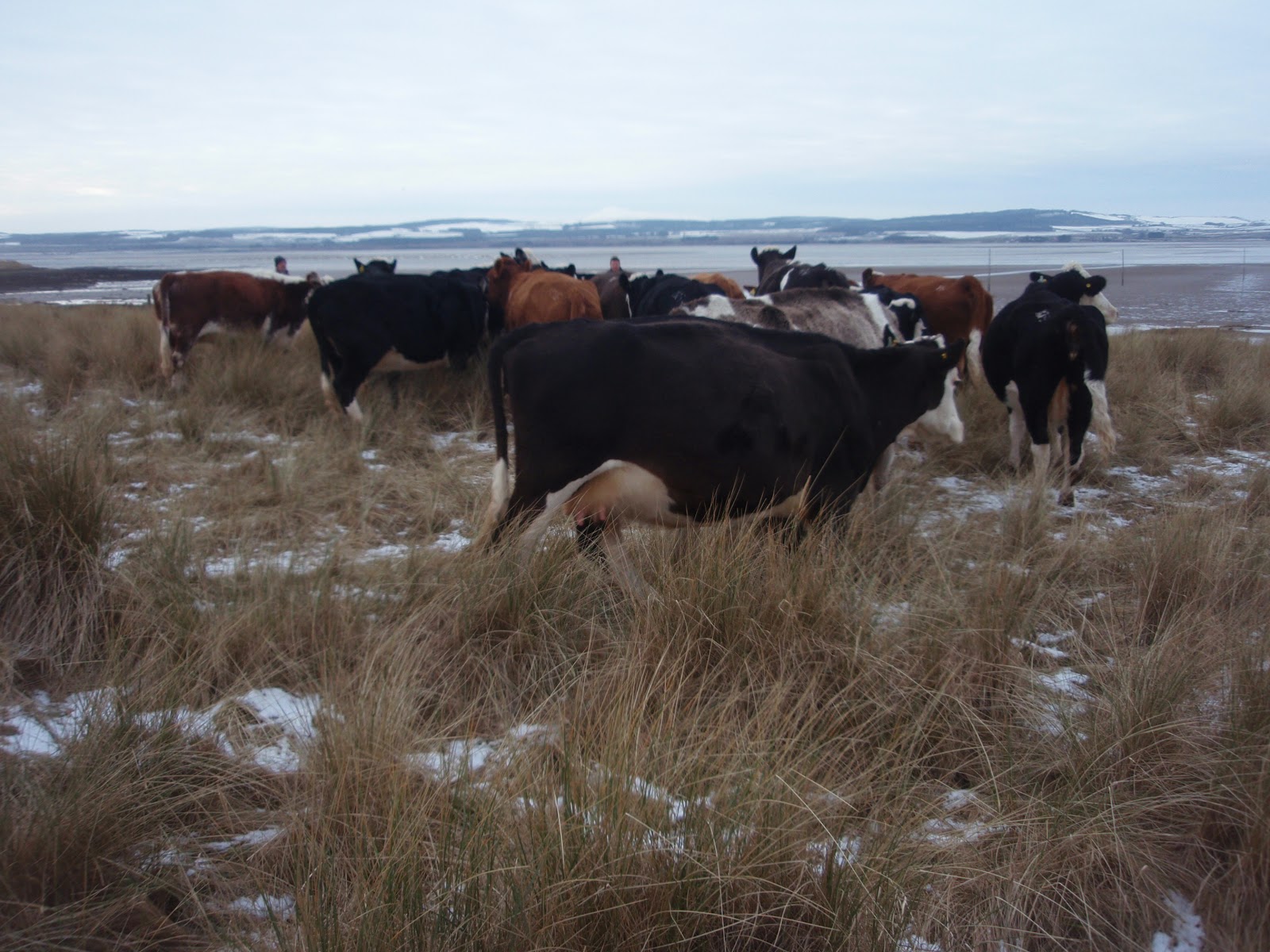
Today began with a search for the cattle among the dunes, in the middle of a hail storm! Thankfully this was followed by blinding sunshine - just going to show how the Reserve can experience all weathers in one day.


A heavy snow and hail shower arrives in the dunes


Lindisfarne NNR's first snowfall of this winter, with a storm cloud in the background

Reserve staff will continue to check our livestock daily, and if we experience prolonged bad weather the stock will be returned to their homes on the mainland for the winter.

Tuesday, 22 January 2013

22nd Jan: Coldness continues


Since our last post the snowy conditions at Lindisfarne have continued. We have been out and about on the Reserve monitoring birds and there has been a definite decrease of species on site. The numbers of Light-bellied Brent Geese present, for example, have decreased. In partnership with our friends in Denmark, we monitor the entire population of the East Atlantic race of Light-bellied Brent Geese, which is made up of around 7,000 birds.

Light-bellied Brent Geese at Lindisfarne (John Dunn)

It is extremely important not to disturb birds in this severe weather as it is vital that they conserve energy. Walking too close to the tidal areas where ducks, geese and waders feed causes them to take flight, which wastes their energy and causes stress, preventing them from feeding, which can be fatal. In these severe conditions feeding is important to give them the energy to stay warm and not lose weight. It is a struggle to feed when the land is covered in snow and the cold causes die-back of the Eelgrass that the ducks and geese feed on. Please be careful not to cause disturbance when walking on the Reserve and keep dogs on leads to prevent them from going too close to birds. It is also important not to approach birds for photographs. One of the main reasons why Lindisfarne has been designated a National Nature Reserve is to protect its birds, and in this weather their protection is vital.

Snow on the Causeway, Holy Island

An advantage to the frost is that it causes dieback of Pirri-Pirri (the invasive plant species mentioned in previous posts). When Pirri-Pirri gets frost damaged, it breaks apart more easily when livestock trample it, helping to reduce its abundance.

The sheep did a good job of targeting the invasive Michealmass Daisy as well as Pirri-Pirri, both of the island’s non-native species. Creeping Willow is a native species but can become a scrub issue if not controlled, and the sheep also did a good job at grazing it. Through enclosing them within an electric fence, they grazed intensively. The fence-line, enclosing about an acre, was moved around to target the most appropriate areas of the dunes. Because Michealmass Daisy is less widespread than Pirri Pirri, this method had a more significant impact. The below photograph, shows the difference the sheep made to the vegetation compared to the un-grazed on the left.

As well as being able to carefully target specific areas, electric fencing is portable and has minimal impact. The cattle require stronger fencing, but Natural England has chosen the least visually-impinging option possible. When taking the cattle off last week, we brought hurdles onto the island and then took them off – this takes time but is an alternative to a permanent corral, which would detract from the natural landscape of the dunes. We also try to keep signage to a minimum for the same reason.

With this season’s grazing complete, we look forward to May when the dunes are awash with flowering orchids. The blog will be updated with wildflower photos throughout the spring and summer so keep an eye out.

Thursday, 17 January 2013

17th Jan: Cows go home

It seems the period of mild weather is over, with temperatures falling below freezing this week and a fall of snow on the east coast.
Looking more like winter on Holy Island

The snow fell thickest around Goswick

Thanks to the favourable conditions, the cattle have done a great job of trampling Pirri-Pirri and grazing the vegetation (which, in the absence of rabbits, is a valuable part of managing the site) and their work for this season is now done. They were taken off this morning as the weather looks set to worsen over the weekend and into next week. They are going back to John Barber's farm inland where they will calf in March.
The dunes on Holy Island

Rounding up the cattle

Local farmer John Barber with his cows

Three Stooges look on

The Barnacle Geese are still on the Reserve, 140 have been feeding amongst Greylag Geese in the fields near Budle Bay where there is less snow. Earlier in the week we conducted a Whooper Swan count, recording 42 on the Reserve. In the tidal areas there are good numbers of Shelduck, with over 1000 counted across the Reserve on Sunday's WeBS count (the Wetland Bird Survey conducted throughout the UK every month - more information on the BTO web-site). The hide at Fenham-Le-Moor is a good place to go to view them, where they stand out against the dark mud, their red bills and chestnut breast-belts catching the winter sun.
Female Shelduck (John Dunn)

Monday, 7 January 2013

7th Jan: Reserve news update

Like most of the UK, the end of December was very wet at Lindisfarne. As a result, there is an usually large amount of standing water on Holy Island. Conveniently, the standing water in the dunes provides natural drinking areas for the cattle. The very mild conditions have enabled the cattle to remain on Holy Island into the new year, in previous years they have been taken back to the mainland in December due to harsh conditions. They continue to graze the vegetation and will remain on the island until around the end of January if the mild conditions continue.

Peak bird counts from December included 21 Red-throated Divers, 3100 Light-bellied Brent Geese, 1350 Shelduck, 2500 Wigeon, 310 Pintail, 350 Common Scoters, 1100 Oystercatchers, 819 Lapwings, 2000 Bar-tailed Godwits, 450 Redshanks and 620 Curlews.

January is a great time for winter walks at Lindisfarne. The Reserve is a great place to come to watch birds and there are fantastic photography opportunities, please be mindful of the codes of conduct (see link). Please do not go too close to birds or seals to prevent disturbance, and stick to paths and existing desire lines to prevent impact to wildlife and their habitats. The hides on the Reserve are the best places to watch birds from, these are at The Lough and Fenham-le-Moor (see leaflet).
Mass flight of Wigeon (John Dunn)

Lapwing (John Dunn)

There is great variety to the work we do at Lindisfarne NNR. Before Christmas, Holy Island resident Alison Brigham rang the office to say she had found an injured Kestrel on her farm. The female Kestrel was dazed and had been attacked by a Sparrowhawk, it may have flown into the overhead power cables. We took it to the Berwick Swan Trust who brought it back to health. Over the years, the Berwick Swan Trust have been very helpful by taking in injured birds found on the Reserve. Jim from Berwick Swan Trust brought the Kestrel back to Lindisfarne on Friday and Alison then released it where she had first found it.


All wild birds are protected by law and it is illegal to kill, harm, exploit or hold a bird in captivity. The law aims to protect wild birds, but not to discourage the public from helping birds in need. However, when handling injured birds, great care should be taken that no harm is caused. Do not handle a wild bird unless it is essential to help it, and only do so if you are experienced and confident.

Tuesday, 11 December 2012

11th Dec: Winter at Lindisfarne


Welcome to our brand new blog for Lindisfarne National Nature Reserve. The Reserve is currently alive with wintering water birds. From the gurgling calls of Light-bellied Brent Geese to the spectacle of two thousand Golden Plover flying together, Lindisfarne truly is a special place to be in the winter. We will be updating the blog throughout the changing seasons with contributions from staff and volunteers.

The Lindisfarne team
Left to right: Andrew Craggs (Senior Reserve Manager), John Woodhurst (Volunteer), Graham Bell (Volunteer), Daniel Richardson (Placement Student), Jo Wilkes (Lead Adviser), Ajay Tegala (Reserve Manager), John Steele (Volunteer)


December has got off to a cold start with northerly winds and temperatures falling below 0C. Light snow fell last Wednesday while we were out on the Snook clearing scrub (mostly Scot's Pine). Reserve staff maintain small areas of scrub primarily for migrant birds, however encroachment is cleared regularly to prevent it from taking over and altering the habitat of the sand dunes and dune slacks.

Scot's Pine on the Snook


Following an exceptionally rainy October, November had several bright and mild days, with the dunes looking golden in the setting afternoon sun. Short-eared Owl sightings have been frequent hunting amongst the dunes with numbers reaching double figures. There have been occasional Hen Harrier sightings throughout November and into December. A small group of Roe Deer can sometimes been seen on the island.

In October there were a number of rare migrants recorded on Holy Island with several sightings of Yellow-browed, Dusky and Barred Warblers as well as a Pied Wheatear. On the 23rd there was a big fall of thrushes having just crossed the North Sea, hundreds of Fieldfares landed in the dunes along with several Blackbirds and Redwings - it was quite an experience to witness these birds literally dropping out of the sky in the mist.

Throughout autumn there were several sightings of Waxwings along the coast and further inland. These fine-looking, Starling-sized birds have flown over from their breeding grounds in northern Scandinavia and Russia to feed on our berries.

Wigeon numbers peaked at 9,000 on the 2nd of November. There are around 2,900 Light-bellied Brent Geese on the reserve, but this could increase in the coming days as the cold temperatures in Denmark (-15C) may cause a number of geese to fly to Lindisfarne. Pink-footed Goose numbers peaked at 3,500 in October. Large numbers of Barnacle Geese pass through in autumn, but this year and last, a group has over-wintered at Lindisfarne, at the moment the group is made up of around 270 geese. Small numbers of Whooper Swans are present on the Reserve and on the 6th of December 42 were recorded just outside the Reserve near Fenham-le-Moor.

Barnacle Geese with Wigeon behind (John Dunn)


Follow our blog to keep up to date with our work and wildlife sightings on Lindisfarne NNR. Throughout the changing seasons we will be reporting on a wide variety of projects including the stock grazing scheme regime and our Reserve events. In the spring and summer we will share our breeding shore bird, small mammal, butterfly and flora data.