Showing posts with label Northumberland. Show all posts

Friday, 1 February 2019

Selected peak bird counts: January 2019

Geese and swans:

6000 Pinks flighted off the Goswick roost mid-month; 1303 Light-bellied Brent; 1000 Barnacle; 41 Whooper

Image ©  JJD

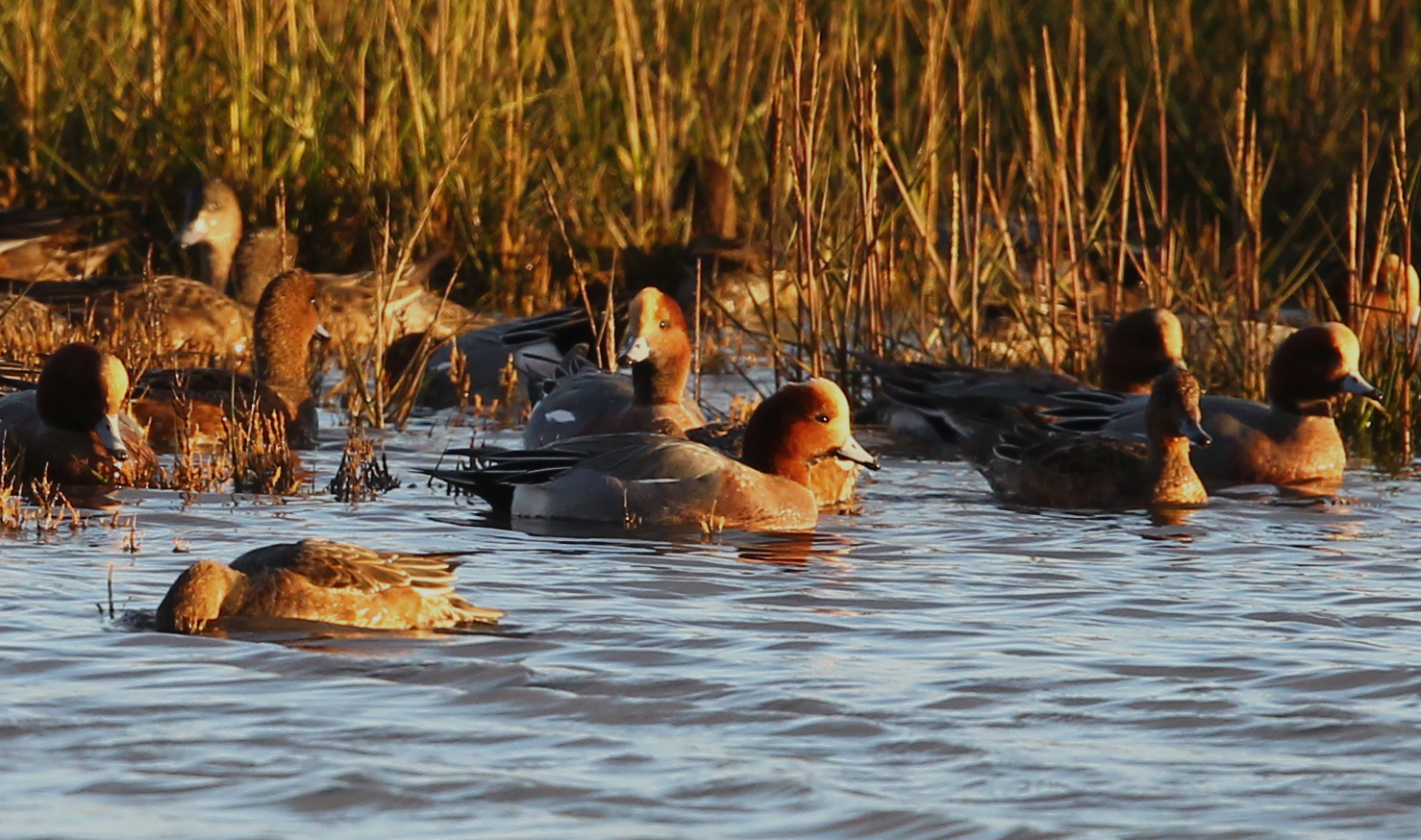
Ducks: 

1900 Wigeon; 1200 Shelduck; 226 Pintail; 5 Long-tailed duck; 1 Black Scoter

Image ©  JJD


Waders: 

3005 Golden Plover; 1018 Grey Plover; 2000 Dunlin; 750 Curlew

970 Lapwing and 2900 Golden Plover recorded during our WeBS count at Budle Bay on the 20th 

Image ©  JJD
The current cold snap means that birds, like us, require more energy to keep warm, and in these wintry conditions they often find it harder to find food. They are particularly vulnerable to disturbance when it is cold - each flight expends a great deal of energy. Repeated disturbance can cause death from starvation or exhaustion. Please keep your distance when birds are roosting or feeding, and keep dogs on a lead on the Reserve at all times. 

Monday, 11 June 2018

Shorebird season: our first little tern egg

As wedding bells pealed in Windsor, and millions of people around the world watched the royal wedding on May 19th, the wardens at Lindisfarne National Nature Reserve were celebrating quite different news – our first little tern egg of the year. Quietly, with no fanfare: one small speckled egg.


If we’d had flags we’d have waved them - it’s what we’ve been hoping, and working, for since long before the beginning of shorebird season. Preparation and planning is year around, and in April staff and volunteers set out laden with fence posts, coils of rope and a heavy mell hammer in order to fence off safe areas for the birds – as well as coils of plastic predator-proof netting to encircle potential nesting sites. Where to put them? Well… who can predict the ways of terns, but based on knowledge of their habits and the evidence of previous years, we fenced off five areas across the reserve, the mell becoming heavier with each post that we drove into the sand.

Little terns are the UK’s second rarest nesting seabird and Britain’s smallest seabird – delicately built, agile and very sweet. Despite their size, they migrate thousands of miles each year – all the way from West Africa to the Northumberland Coast. I’d never seen one except in photographs. You’ll love them, I was told. But where were they? We’d expected them at the beginning of May yet this brought only a couple of pairs to the reserve. Everything was ready… but the terns were late. Days passed. Where we had expected flapping, squeaking busyness, there was only silence and stillness. We began to wonder – would they come at all? What had happened, so far away?

Then news – on Twitter, appropriately enough – from the south: they’re on their way. Sussex had started to see their terns arrive. A message of hope for the north – and gradually, finally, they arrived, squeaking like rubber balls and dipping into the surface of the sea for fish. We still didn’t know what had delayed them, but they were here – and, we hoped, ready to mate. What’s the tern equivalent to mood lighting and Marvin Gaye? we wondered. Their late arrival meant there wasn’t much time… time to break out the really good sand eels.


In the meantime, shorebird wardens were watching the sites – watching, waiting, and commiserating with those whose walks were cut shorter by the fenced off areas. The little terns are a Schedule 1 species, meaning it is a criminal offence to disturb them. Sadly there are many hazards for a species that lays its eggs in small scrapes in the sand – including, but not limited to crows, gulls, kestrels, foxes, humans, dogs off leads, high winds, high tides, and their own sometimes poor sense in choosing nesting spots. After the joy of our first egg, the fear (I wonder: is this what parenthood feels like?). They are so very vulnerable. Yet these brave little birds return, year on year. And we do what we can to help.

Yet every intervention is a gamble - putting up the predator-proof netting runs the risk of treading on scrapes or eggs, causing the birds to lose their bearings, or simply leading them to abandon the site. We move swiftly and carefully to complete the tasks - normally barefoot. Every now and then a sharp blade of the marram grass on the dunes prompts an exclamation, but we keep moving - eyes downward - as the terns flutter and squeak above us. We have ten minutes, max - in and out. Fingers fumble. We’re near the end of our time.


And then it is done and we move fast, a bee line to the dunes. We throw ourselves down, breathless, out of sight. Eyes glued to binoculars, we wait. Will they return? Will they find their scrapes? Have we done more harm than good? It’s a gamble, always. We wait, and wait... and after about ten minutes are rewarded in our efforts by the sight of the terns returning, one by one, to their scrapes. A quick count. A sigh of relief. They’re okay. Tonight, our local Mr Fox - however fantastic - will have to seek easier prey.

It’s an intense time, and though each successful stage comes as a relief it isn’t until the end of shorebird season that we’ll be able to really breathe again. When, we very much hope, we will see our little terns fledge. We celebrated our first egg. We’ll celebrate our first chick. But our first fledgling? Deck out the beach in bunting and ring the bells. We might even run to a commemorative plate.


Lindisfarne National Nature Reserve is situated on the North Northumberland coast and includes not only the Holy Island of Lindisfarne but 3500 hectares covering 65km of coastline. It is managed by Natural England. Our work with shorebirds is powered by both staff and volunteers and is part of The Little Tern Recovery Project – this work is part funded by the EU Life+ Nature Programme. If you are interested in volunteering on this or other projects on the reserve, please contact Annie Ivison at annie.ivison@naturalengland.org.uk or on 01289 381470.

Photographs copyright to Kevin Simmonds. Little terns are a schedule one species and may only be photographed by those with a license to do so. 


Tuesday, 21 November 2017

November 2017-Panoramic Veiw of Budle Bay Flats


Panoramic Views from the White Railings


The white railings by the road north after Bamburgh provide panoramic views of Budle Bay mudflats.


Image 1: Budle Bay ©JJD


A wide array of bird life can be seen at all stages of the tide as it ebbs and flows from this vantage point. Binoculars or better still a telescope will enable good views of birds that make use of this precious ecological resource.


Image may contain: 2 people, people smiling, people standing, outdoor and nature
Image 2: Enthusiasts watching birds on the mudflats of Budle Bay during one of the organised ‘Migratory Bird Watch’ events ©Natural England/Annie Ivison


The best time to see birds here is throughout the autumn and winter months, when resident birds are joined by migrant geese, swans, ducks and waders, sometimes in huge numbers.

Image 3: A Mute swan on the waters of the reserve ©JJD
Image 4: A Curlew wading the mud ©JJD
Image 5: Light-bellied Brent geese from the Svalbard population feeding on seagrasses that are abundant across the mudflats at Fenham and Budle Bay ©JJD                    


Being adjacent to the North Sea coast, hard weather on continental Europe can result in even greater numbers of avian visitors


Birds to look out for are Shovellers and Pintail, among flocks of Wigeon, Teal and Mallard.
At high tide, Glavonian and Red-throated Diver are frequently spotted, fishing the deeper river channels.


Blog written by an NNR volunteer


Birds at Budle Bay should be observed from behind the railings, ideally on a rising tide, which will draw the birds closer to the observer.

Plans are underway to build a new viewing platform at Budle Bay, this will provide an excellent space for viewing birds without disturbing them...watch this space!


   https://www.facebook.com/lindisfarnennr/

Monday, 7 September 2015

Brent Arrival

It's the time of year where we start to welcome our Scandinavian visitors such as light-bellied Brent geese to the reserve. Last week we had small groups of around 10 brent geese noted and numbers have continued to rise to around 300 today. With a peak of around 3,000 last year the arrivals have just started.


(c) JDD
 

Thursday, 27 August 2015

MarClim Surveys

The Lindisfarne intertidal rocky reefs are one of the many MarClim sites surveyed on an annual basis to investigate the effects of climatic warming on marine biodiversity. An important habitat on the reserve, the rocky reef is the place where land meets sea which provides a diverse but hostile environment.


The MarClim project builds on data already collected to investigate the effects of climate change on the marine environment. An extension of the Marine and Climate Change Program which ran from 2002-2005 the project surveys rocky reefs around the country on a yearly basis.


An interesting project highlighting the importance of long term data sets. You can find information on the data collated and collected by the MarClim project via the National Biodiversity Network Gateway (www.searchnbn.net) or by contacting the
Marine Environmental Change Network (MECN) Co-ordinator (www.mba.ac.uk/MECN).


Nova Mieszkowska (MBA) and Heather Sugden (Univeristy of Newcastle) surveying Lindisfarne inter-tidal rocky reefs


Friday, 14 August 2015

New Lough Hide

Recently the new hide at The Lough was finished. We are currently looking to get some information in the hide to tell visitors a little bit about the NNR and Natural England. We put a diary for people to put there sightings. It was lovely that after two days it had already been used and here are a few pictures of what was in it below.


Thursday, 13 August 2015

Bird walk a great success

You may have noticed that last month we had a guided walk led by Graham Bell. Weather on the day looked like it could turn wet however we all plowed on and had a lovely walk. Walking down the Crooked Lonnen Graham encouraged us to stop and appreciate even the most common species. He told us all about the common daisy, doves and pigeons among others and we came to the understanding that everything really does have an interesting story attached it. Following round the wagon way we came to the new Lough hide which provided a welcomed stop. Here we were treated to grand views of tufted duck, little grebe and swallows and martins playing in the reeds. A brief look at some of the wildflowers on the way round to the Straight Lonnen and it was brilliant to hear about the grass of Parnassus and stumble upon a garden tiger moth almost as if Graham had placed it there on the path to find.
The new Lough hide - a mid way point to our walk.

Graham showing birds foot trefoil to he group and demonstrating where the name comes from.

Thank you to Graham Bell for guiding the walk

Wednesday, 12 August 2015

Shorebird season round up

Well that's us all packed up for another season - fences are in and signs are down. Chantal - project co-ordinator for Northumberland Little Tern Project has put together a summary of the season below:


Just as the summer is almost over, the shorebird breeding season is coming to an end. Those who have been lucky enough to visit the beaches this summer;relax, walk their dog and enjoy having a wander may have seen shorebirds such as ringed plovers and oystercatchers nesting on the sand.

However humans are not the only visitors that gather at that time! Several tern species (including Arctic and Common terns) make the journey back to the UK from their wintering grounds to breed and nest on our beaches. Among them is the charismatic ‘Little Tern’ (Sternula albifrons) which are the second rarest breeding seabird in the UK. Aptly named, they are no bigger than a blackbird; however they make a lengthy journey every April travelling up from their wintering grounds of South and West coast of Africa to the UK.

It has been a difficult season this year with low recruitment of some species like our rare little tern, the second rarest seabird to breed in the UK of which there are only 45 pairs in Northumberland. However all shorebirds are affected by predation, erosion, tides, disturbance and especially at the start of this summer: the cold weather.


One of our rarest shorebirds the Little Tern nests along the Northumberland Coast.


Although breeding shorebirds are anywhere on the beache, this year, potential sites were cordoned off with fencing. A variety of fencing was used to make for optimum success. Approximately 2.5km of blue exterior rope was used in addition to 1km or electric wire and 1.5km mesh netting. Electric fencing is a good defence in preventing mammalian predators such as foxes, but the blue exterior fencing has worked very well in warning beach-users from walking too close to the scrapes and disturbing the incubating birds of eggs/chicks, thus reducing the risk of nest failure due to exposure.


Wardens have been out on the beach all summer speaking to the public and monitoring shorebirds


In addition, 40 information signs as well as Shorebird leaflets were placed at access points to beaches informing the public of the summer restrictions and presence of breeding shorebirds. One of the main signs focused on asking people to keep their dogs on a lead to avoid disturbing breeding birds in both the dunes and on the beaches.

Our Shorebird leaflet available to download on the blog
Over the summer we have had a hardworking team of Shorebird Wardens and volunteers who have been both observing shorebirds and engage the public. They have been either on-site informing people about the reasons for shorebird decline or at events such as ‘Shorebird Celebration.’

We also had an engaging end of season discussion between staff and volunteers from both Lindisfarne NNR and the National Trust discussing the success of shorebirds across Northumberland.

As the season is now over, we can now say that with all of these contributions, the shorebirds breeding season has resulted in high productivity, with good numbers of Common, Arctic and Little terns and average numbers for ringed plovers.


For anyone who would be interested in joining our numbers and protecting our rare little terns & other important shorebirds next summer, please get in contact: northumberlandlittleterns@gmail.com


Fencing all cleaned off and ready to be stored for next year.

Saturday, 1 August 2015

Life in a dune slack on Lindisfarne NNR


This week we carried out an ‘Integrated Site assessment; (ISA) on the Snook, Lindisfarne SSSI. The purpose of the ISA was to assess the condition and management of the dune slack and sand dune vegetation which are protected under the SSSI designation.

Historically used to stuff mattresses the delicate ladies bedstraw can be seen throughout the dunes at this time of year. 

We have an abundance of the brightly coloured burnet moth on the reserve at the moment.

Garden Tiger moths are more commonly found flying at night. This picture shows the beautiful pattern which shows where it gets it's name.

During the assessment we identified lots of exciting and rare plants and invertebrate species including: coral-root orchid (Corallorhiza trifida), Shoreweed (Littorella uniflora),Lindisfarne hellaborine found only on Lindisfarne, green fritillary butterflies and the Isabella Tiger moth.


  Katie Coombs SSSI Officer

Monday, 13 July 2015

School group explore the reserve

At the weekend we had a school group from Ponteland out on the reserve. They came to explore the reserve using bikes. We had a great day trying to spot as many species as possible whilst we rode between activities with Dave and Heather .


There is no cycling on the NNR itself so bikes were left securely on the cycle paths and at designated spots while the kids walked onto the reserve for beach art, rock pooling and exploring.
Below is a picture from Dave's twitter showing NNR staff talking to the group before going on the beach to learn to make some beach art.


Sunday, 12 July 2015

County Flower On Show

The reserve stretches to Cheswick Black Rocks and whilst accessing from the carpark at Cheswick there is an aray of different flowers and sun traps for butterflies. In particular Bloody Cranesbill (Geranium sanguineum), the county flower of Northumberland, ensures the dunes are awash with a bright purple colour.


Wednesday, 24 June 2015

Spot the Eider Chicks

There are several eider creches using the reserve at the moment and I stumbled on one whilst out doing a breeding bird survey. Out on the rocky shore you can see how camouflaged they are against the rocks and seaweed. There were 10 in this particular group so I moved away and left them in peace.


There is always something new to look and below is some interesting cloud formations visible over the dunes last week.
 

Friday, 29 May 2015

Holy Island Creche

We saw our first eider chicks on bank holiday monday and having spied them from the causeway today the original three seem to have been joined by a couple more. They look to be forming the famous eider creche which sees the females taking care of several broods of chicks together. Here's a couple of pics of eider taken previously as the causeway was a little busy for me to stop and take some more.


JJD(C)

Friday, 22 May 2015

Friday Facts

Having just started as reserve warden I was asked to put together a fact file for our educational outreach info. From a newbies point of view it was a great opportunity to delve a little deeper into the NNR and how it came about. So here goes are you ready for some Friday facts?

                                          When looking at the information leaflets about the reserve I kept noticing that it covers of 3,500 hectares. Hectares may not mean much but with a quick web search I found that this relates to well over 3,500 Wembly football pitches. Stretching from Cheswick Black Rocks in the North to Budle Bay in the South it's not surprising when you also hear that Lindisfarne is one the largest Reserves in the North East covering a mosaic of internationally important coastal habitat.


The Reserve is half a century old and has seen some changes in those fifty years. The causeway was completed two years after designation as a National Nature Reserve. It was designated a Site of Special Scientific Interest in 1989 and a Ramsar site for it's important wetland habitats in 1976. For more information on Ramsar sites including Lindisfarne have a look here.

JJD (c)

What about the star species for the reserve and what makes them special?

  • The Reserve has its own endemic wild flower the Lindisfarne Helleborine which is only found on Holy Island. 
  •  All 4 species of UK terns have bred on Lindisfarne in the past.   All species of tern migrate large distances to breed on the NNR. Arctic terns in particular can travel up to 70,000km every.   The total distance flown in an Arctic Terns life time may exceed 2.4 million km.
  • One of the Reserves star species is the Light- bellied Brent geese and Lindisfarne NNR is their only regular wintering site in Britain
      There are plenty more facts and information about the Reserve on our leaflet which you can download from this blog and on our information panels around the reserve.


Wednesday, 20 May 2015

Champions for shorebirds on the NNR

Another shorebird update!

With the help of external funding we have a new shorebird warden who started this week. Richard has joined us for the summer season and in additional to staff and volunteers will be out and about around the NNR talking to visitors and making sure shorebirds are given the room they need to breed. He will be joined shortly by another warden, Laura, who will be taking up the gauntlet later in the month. Say hi to them if you see them out on the beach and help make their job a little easier by being aware of sensitive breeding areas whilst on the beach. Download our leaflet 'Sharing Our Beaches with Birds' for loads more info.


Sorry not a picture of the Richard the new warden - I'll get one of them out and about for the next blog!

Wednesday, 13 May 2015

Fences go up


Over the last week staff and volunteers have been putting up temporary protective fencing around the reserve. The fencing will allow shorebirds on the NNR to have a little bit of the Northumberland beach just for them without the threat of disturbance. 

Whilst out and about we had Ringed Plovers already incubating eggs. The eggs are so small and camouflaged it is easy to see how they could be trampled. 

Ringed Plover footprints on the beach. If you see a lot of these in an area it could indicate activity. 

We've been putting up outer fences with blue rope and signs - please don't go past them.

Friday, 24 April 2015

Sharing Our Beaches With Birds

 We are a partner of The Northumberland Little Tern project and we've been  putting together some information in a leaflet on how to enjoy the beach responsibly. The hope is the leaflet will help visitors to our beautiful coast enjoy their time whilst also ensuring shorebirds have the room they need during the breeding season. There’s also a nifty shorebird I.D. guide to take with you on your walk. It's been part funded by EU LIFE+ as part of the national Little Tern Recovery Project.
The front cover of our free new leaflet. Photo of little tern by K . Simmonds

We are just putting the finishing  touches to it and will be officially launching it in the next few weeks so watch this space.

Hopefully we’ll be getting the leaflets into a whole host of places including Tourist information centers which will give visitors a chance to read them before they arrive. If you are local business or give information out  and are interested in pre-ordering some copies then please get in contact with the reserve office and we can sort out getting some to you.  


Tuesday, 21 April 2015

Shorebirds in the press again

Great to see fences for shorebirds going up further down the coast at Druridge Bay - it's getting to the time of the year where we'll be dusting off the electric fences and doing the same up here.


Volunteers helped sort and store fencing from last year.